Last updated 31 October 2026
Where does the office time go in a construction business?
The work happens on site, but a big part of the week happens in the office. Proposals and tender responses, site and client meetings that need writing up, subcontractors and suppliers to follow up, variations to chase, invoices to raise and get paid, and the books to reconcile before the accountant asks. In a smaller firm, much of it lands on the owner, after hours.
AI is good at the office side of that list. It can read a meeting and pull out the actions, draft a follow-up, build a document from information you already hold, and keep the books moving. It does not replace the people who know the job. It takes the typing, copying and chasing off them.
What does Seby take off the office?
Seby is one brain with engines on top. Each engine runs one slice of the back office, and you switch on the ones you need, starting with the job that costs you the most time.
Proposal engine
Proposals from a brief
A brief goes in, the research gets done, a branded proposal or deck comes out, with e-signature built in.
Meetings engine
Meetings written up by morning
Every meeting recorded, classified and debriefed by morning, with the actions pulled out and assigned.
Comms engine
Follow-ups that actually go out
Inbox triaged, replies drafted in your voice, follow-ups written from your meetings. Nothing sends without your say-so.
Billing engine
Invoices out, payments chased
The moment a deal is signed, the invoice goes out, the payment link is sent, and it chases until you're paid. Credit card or bank.
Finance engine
Books kept current
Bookkeeping and reconciliation into Xero, exceptions surfaced before they become problems, payroll previewed two days before it runs.
Reporting engine
Reports before the meeting
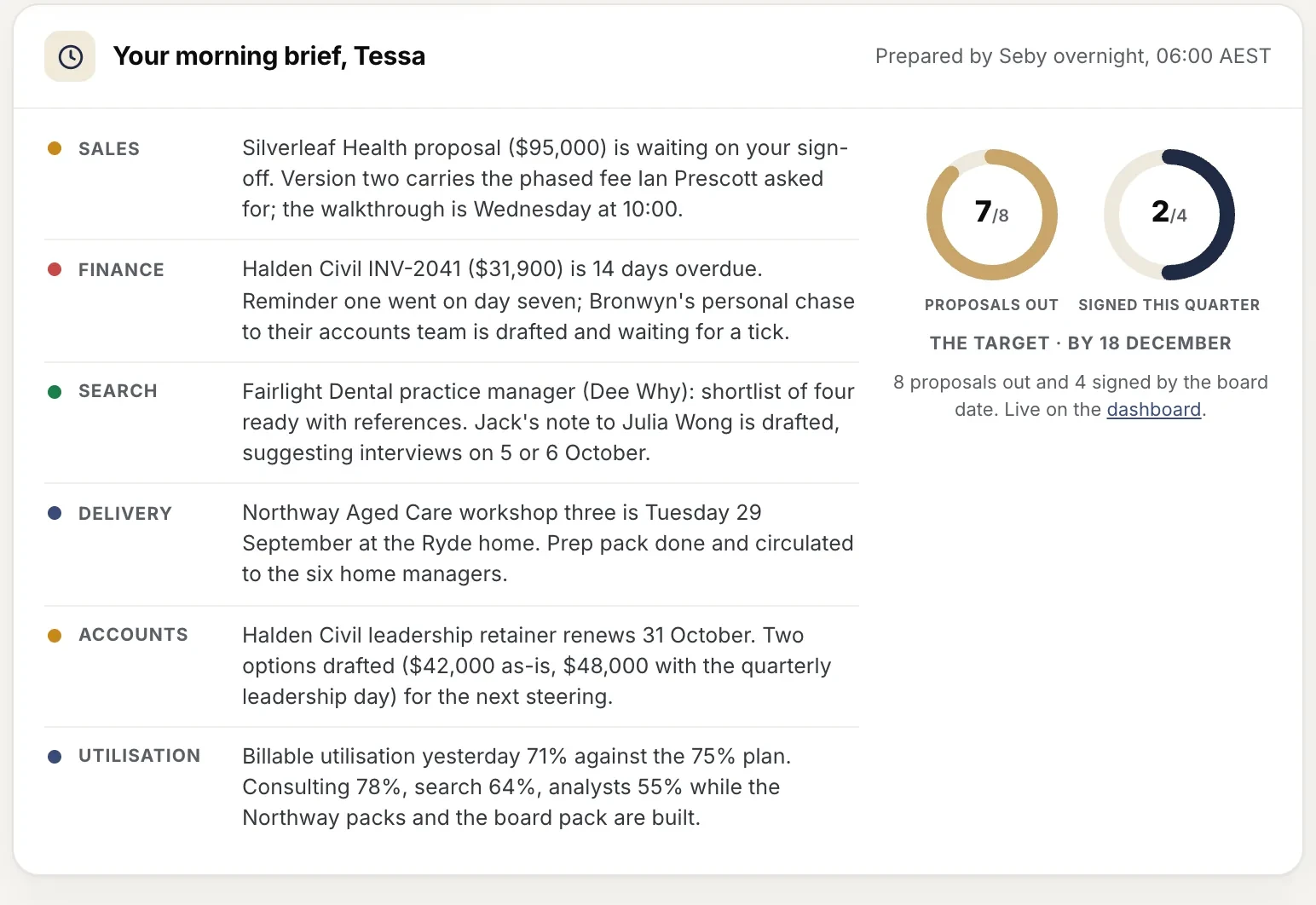
Leadership briefs, board packs and dashboards written before the meeting. You never start a report from a blank page.
The agent sits in your Teams or Slack. Ask it anything about the business and it answers with the source, from everything you connect. See every engine.
What has Seby already done for a fabricator?
One example from the work we shipped for customers in the last 90 days.
Shipped for a customer
Shop drawings from a marked-up sketch
A fabricator marked a section on an architect's sheet and sent it by text. The brain produced the drawing set, revision by revision, as PDF, DXF and DWG, with every assumed value flagged for the engineer by name.
That is the pattern for construction work. The system does the drafting, and the person who carries the responsibility checks what it assumed. In another install, a customer texts a change to their website, and the agent edits it and proves the live page changed, with approval staying with a human by default. More on the proof page.
How does invoicing work for a construction firm?
Seby Billing is the billing system we built to run our own books. It issues, sends and reconciles invoices itself.
Runs itself
An agent issues the invoice, emails it, watches the bank, reconciles the payment, and chases what is late. You approve, it does the rest.
Pay like a local, anywhere
Local bank details in AUD, NZD, USD, GBP, EUR and AED on every invoice. Your customer pays a normal domestic transfer. No card fees.
Gets the tax right
Correct GST, compliant tax invoices, a clean audit trail, and a hosted page where the status flips to paid on its own.
Behind it, the Finance engine handles bookkeeping and reconciliation into Xero and surfaces exceptions before they become problems. For the basics, read what is automated invoicing and how to automate invoicing.
Does it work with the systems we already use?
Yes. Nothing gets replaced. Seby connects to what you already run:
- Microsoft 365: Outlook, Teams, SharePoint, OneDrive
- Google Workspace: Gmail, Calendar, Drive
- Slack
- Xero
- Stripe and your bank feed
- Dropbox
- Your meeting recorder
- Your website
If you run specialist construction software, that is a custom integration: we scope it on a call and quote it per tool. The full list is on how it works.
Who checks the work?
You do, by design. Nothing sends without your say-so. Drafts come to a named person first, and every question and answer is kept in an audit log. Your firm gets its own brain on a machine dedicated to you, your data is never used to train any model, and it never reaches another business. The detail is on the trust page.
How long does it take, and what does it cost?
Weeks 1 to 2 are an audit and plan: we sit inside your inbox, meetings and systems and map where the week actually goes. Weeks 3 to 12 are the build and install. In months 4 to 6 we run it alongside your team, then hand over with your own operator trained. A single engine can be running in weeks.
Every plan includes the Brain. Priced in USD, billed monthly. No lock-in. See pricing for every plan, and our guide on what AI back office automation costs.
Questions construction business owners ask
What does AI operations mean for a construction company?
It means using AI to run the office side of the business: proposals, meeting notes, follow-ups, invoices, bookkeeping and reports. With Seby, one shared brain reads your email, meetings and files and drafts that work for a person in your firm to approve.
Can Seby help us get paid faster?
Seby Billing issues the invoice the moment a deal is signed, sends the payment link and chases until you're paid. Invoices carry correct GST and local bank details in six currencies, with no card fees, and payments reconcile themselves.
Does it replace our accounting or project software?
No. Seby runs on top of the tools you already use, including Xero, Microsoft 365, Google Workspace and Slack. Specialist software is connected as a custom integration, scoped and quoted per tool.
Does anything go to a client or supplier without our approval?
No. Nothing sends without your say-so. Drafts come to a named person first, and the agent keeps a full audit log of every question and answer.
How long until it is running?
A single engine can be running in weeks. The full operating system is deployed inside your firm in 12 weeks, with handover to your own trained operator by month six.
What does it cost?
Plans start from US$1,999/mo for a single engine, with the Brain included. Priced in USD, billed monthly. No lock-in, cancel anytime.